CPU base class for executable programs. More...
#include <rexlib/backends/cpu/cpu_program.hpp>
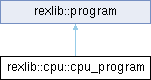
Inheritance diagram for rexlib::cpu::cpu_program:
Public Member Functions | |
| virtual void | execute (span< const std::shared_ptr< buffer > > outputs, span< const std::shared_ptr< const buffer > > inputs, span< const std::shared_ptr< buffer > > scratch, thread_pool &pool) const =0 |
| Immediately execute the the program. | |
 Public Member Functions inherited from rexlib::program | |
| program (const program &other)=delete | |
| program (program &&other)=delete | |
| program & | operator= (const program &other)=delete |
| program & | operator= (program &&other)=delete |
| virtual span< const program_scratch_requirement > | get_scratch_requirements () const |
| Queries the scratch buffer requirements for this program. | |
Detailed Description
CPU base class for executable programs.
Member Function Documentation
◆ execute()
|
pure virtual |
Immediately execute the the program.
The pool travels with the call rather than with the program because a program is built once and run many times, possibly against queues that do not share their threads. It is the queue running the program that knows which threads the program may use, so it says so here.
A program is free to ignore it and run on the calling thread. Whatever it does, the call returns only once the program has finished: the operands are spans the caller owns, and they stop being valid when command_queue::submit returns.
- Parameters
-
outputs Output buffers. Neither may be null. inputs Input buffers. Neither may be null. scratch Workspace buffers. Neither may be null. pool The threads the program may spread itself over.
The documentation for this class was generated from the following file:
- rexlib/backends/cpu/cpu_program.hpp