Write evenly spaced samples of the segment from start to stop. More...
#include <rexlib/ops/creation/linspace_operation.hpp>
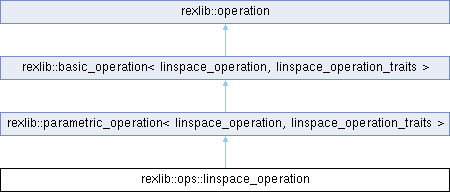
Public Member Functions | |
| linspace_operation (const scalar_value &start, const scalar_value &stop, std::size_t count, bool endpoint=true) | |
| Construct a linspace operation. | |
| const scalar_value & | get_start () const noexcept |
| Get the value of the first element. | |
| const scalar_value & | get_stop () const noexcept |
| Get the end of the sampled segment. | |
| std::size_t | get_count () const noexcept |
| Get the number of samples written. | |
| bool | get_endpoint () const noexcept |
| Check whether the stop is itself a sample. | |
 Public Member Functions inherited from rexlib::parametric_operation< linspace_operation, linspace_operation_traits > | |
| parametric_operation (Args &&... args) | |
| Construct the operation by constructing its parameters. | |
| const parameters_type & | get_parameters () const noexcept |
| Get the parameters of the operation. | |
| const operation_signature & | get_signature () const noexcept override |
| Get the signature deciding the shape and data type of the operands of this operation. | |
| Public Member Functions inherited from rexlib::basic_operation< Derived, Traits > | |
| const operation_descriptor & | get_descriptor () const noexcept override |
| Get the description of this operation. | |
| operation_id | get_id () const noexcept override |
Get the identifier of Derived. | |
| Public Member Functions inherited from rexlib::operation | |
| operation (const operation &other)=delete | |
| operation (operation &&other)=delete | |
| operation & | operator= (const operation &other)=delete |
| operation & | operator= (operation &&other)=delete |
Additional Inherited Members | |
| Public Types inherited from rexlib::parametric_operation< linspace_operation, linspace_operation_traits > | |
| using | parameters_type = typename Traits::parameters_type |
| using | signature_type = rule_signature< shape_rule_type, type_rule_type, parameters_type > |
| Public Types inherited from rexlib::basic_operation< Derived, Traits > | |
| using | traits_type = Traits |
| using | shape_rule_type = typename Traits::shape_rule_type |
| using | type_rule_type = typename Traits::type_rule_type |
| Static Public Member Functions inherited from rexlib::basic_operation< Derived, Traits > | |
| static const operation_descriptor & | get_static_descriptor () noexcept |
| Get the description shared by every instance. | |
| Static Public Attributes inherited from rexlib::basic_operation< Derived, Traits > | |
| static REXLIB_CONST_CONSTEXPR std::size_t | output_operand_count |
| static REXLIB_CONST_CONSTEXPR std::size_t | input_operand_count |
Detailed Description
Write evenly spaced samples of the segment from start to stop.
Unlike arange_operation this is told how many samples it wants and works the spacing out from them, which is what makes the two complementary rather than redundant: one is exact about the step and approximate about the length, the other the other way round.
When the stop is included it is written verbatim into the last element rather than being left to fall out of the arithmetic, so that both ends of the segment are exact whatever the spacing rounds to. A single sample has no interval to span and takes the start.
The domain is the inexact types. Evenly spaced samples of a segment are generally not whole numbers, so an integer result would be a truncation dressed up as a sequence; arange_operation is the one that enumerates integers. Complex samples are admitted: a segment of the complex plane is as well defined as one of the real line.
Constructor & Destructor Documentation
◆ linspace_operation()
| rexlib::ops::linspace_operation::linspace_operation | ( | const scalar_value & | start, |
| const scalar_value & | stop, | ||
| std::size_t | count, | ||
| bool | endpoint = true |
||
| ) |
Construct a linspace operation.
- Parameters
-
start Value of the first element. stop End of the segment being sampled. count Number of samples to write. endpoint Whether stopis itself a sample. When it is not, the samples are those of the half open segment, so that consecutive blocks of them tile the line without repeating a value.
Member Function Documentation
◆ get_count()
|
noexcept |
Get the number of samples written.
- Returns
- std::size_t The sample count.
◆ get_endpoint()
|
noexcept |
Check whether the stop is itself a sample.
- Returns
- bool The endpoint flag.
◆ get_start()
|
noexcept |
Get the value of the first element.
- Returns
- const scalar_value& The start of the segment.
◆ get_stop()
|
noexcept |
Get the end of the sampled segment.
- Returns
- const scalar_value& The stop.
The documentation for this class was generated from the following file:
- rexlib/ops/creation/linspace_operation.hpp