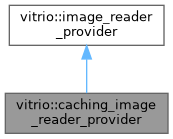
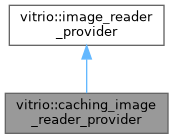
A provider that keeps the readers it was last asked for. More...
#include <vitrio/caching_image_reader_provider.hpp>
Public Member Functions | |
| caching_image_reader_provider (std::shared_ptr< image_reader_provider > backing, std::size_t capacity) | |
| Construct a cache in front of another provider. | |
| std::size_t | get_capacity () const noexcept |
| Get the number of readers this may keep open at once. | |
| std::size_t | get_reader_count () const noexcept |
| Get how many readers are kept open. | |
| std::shared_ptr< const image_reader > | acquire (const std::string &key) override |
| Get the reader a key names. | |
 Public Member Functions inherited from vitrio::image_reader_provider Public Member Functions inherited from vitrio::image_reader_provider | |
| image_reader_provider (const image_reader_provider &other)=delete | |
| image_reader_provider (image_reader_provider &&other)=delete | |
| image_reader_provider & | operator= (const image_reader_provider &other)=delete |
| image_reader_provider & | operator= (image_reader_provider &&other)=delete |
Detailed Description
A provider that keeps the readers it was last asked for.
Opening a file costs a system call and a header read, which asking for the same few files over and over repeats for nothing. This keeps a bounded number of readers open, each under the key it was asked for with, and evicts the least recently asked for when it is full. A key it holds is served without opening anything, and becomes the last to be evicted.
It is a decorator over another provider, not a second opener: on a miss it asks its backing provider and keeps what it gets, so it caches the readers of any provider alike.
The capacity is a file descriptor budget, which is why it is stated in entries rather than in bytes.
- Thread safety
- acquire may be called concurrently. The lock is not held while the backing provider opens a file, so two concurrent calls missing on one key may both open it and one of the two readers is kept; that wastes an open and never costs correctness, since either reader serves equally. Handing out
shared_ptrmeans the one not kept stays alive as long as it is read through, and so does an evicted one.
Constructor & Destructor Documentation
◆ caching_image_reader_provider()
| vitrio::caching_image_reader_provider::caching_image_reader_provider | ( | std::shared_ptr< image_reader_provider > | backing, |
| std::size_t | capacity | ||
| ) |
Construct a cache in front of another provider.
- Parameters
-
backing The provider asked on a miss. capacity Most readers to keep open at once. Must be greater than zero.
- Exceptions
-
std::invalid_argument If backingis null orcapacityis zero.
Member Function Documentation
◆ acquire()
|
overridevirtual |
Get the reader a key names.
Shared ownership rather than a reference, so that a reader the provider stops keeping stays alive for as long as it is still read through.
- Parameters
-
key Key of the file to read, such as its path.
- Returns
- std::shared_ptr<const image_reader> The reader, never null.
- Exceptions
-
image_file_error If the file does not exist or can not be read. unsupported_operation_error If no format can read the file. image_file_format_error If the file is malformed or truncated.
Implements vitrio::image_reader_provider.
◆ get_capacity()
|
noexcept |
Get the number of readers this may keep open at once.
- Returns
- std::size_t The capacity, in entries.
◆ get_reader_count()
|
noexcept |
Get how many readers are kept open.
- Returns
- std::size_t The number of entries, never above get_capacity.
The documentation for this class was generated from the following file: