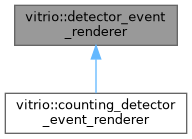
Abstract way of turning the events of a detector into an image. More...
#include <vitrio/detector_event_renderer.hpp>
Public Member Functions | |
| detector_event_renderer (const detector_event_renderer &other)=delete | |
| detector_event_renderer (detector_event_renderer &&other)=delete | |
| detector_event_renderer & | operator= (const detector_event_renderer &other)=delete |
| detector_event_renderer & | operator= (detector_event_renderer &&other)=delete |
| virtual std::vector< std::size_t > | get_image_extents (const detector_event_timeline_descriptor &events) const =0 |
| Get the extents of the images rendered from an acquisition. | |
| virtual numerical_type | get_data_type () const noexcept=0 |
| Get the data type images are worked out in. | |
| virtual void | render (const detector_event_timeline_descriptor &descriptor, const detector_event_timeline &events, array_ref destination) const =0 |
| Render events into an image. | |
Detailed Description
Abstract way of turning the events of a detector into an image.
A renderer is given events and fills an image with them, whatever the time they span: which events make an image is decided by whoever hands them over. What an image is made of, be it a count of the events per pixel or anything worked out of them, is the business of the renderer, as are its extents and the data type it is worked out in.
- Thread safety
- Every method may be called concurrently.
- See also
- detector_event_timeline
Member Function Documentation
◆ get_data_type()
|
pure virtualnoexcept |
Get the data type images are worked out in.
Rendering into an image of that type converts nothing, which makes it the cheapest to ask for.
- Returns
- numerical_type The data type. Never unknown.
Implemented in vitrio::counting_detector_event_renderer.
◆ get_image_extents()
|
pure virtual |
Get the extents of the images rendered from an acquisition.
- Parameters
-
events The grid the events are placed on.
- Returns
- std::vector<std::size_t> The extents of an image, slowest axis first.
- Exceptions
-
std::invalid_argument If this renderer can not render events placed on the grid of events.
Implemented in vitrio::counting_detector_event_renderer.
◆ render()
|
pure virtual |
Render events into an image.
Every element of destination is written, whatever it held before. Values are converted to its data type as a cast between the two types does.
- Parameters
-
descriptor The grid the events are placed on and the time they span. events The events to render. Must have the rank of descriptor, and every coordinate must lie within its extents.destination Where the image is written. Must be initialized and have the extents get_image_extents gives for descriptor. It may be strided.
- Exceptions
-
std::invalid_argument If this renderer can not render events placed on the grid of descriptor, ifeventsdoes not have its rank, or ifdestinationis not initialized or does not have the extents of an image.std::out_of_range If an event lies outside the grid of descriptor.unsupported_operation_error If the data type of destinationcan not be produced from that of get_data_type.
Implemented in vitrio::counting_detector_event_renderer.
The documentation for this class was generated from the following file:
- vitrio/detector_event_renderer.hpp